Monday, January 16, 2012

Now FInd "Home Science" Projects at Your Bookstore!


It's been a while since I updated this blog. Among the things that has been keeping me busy is contributing ideas to GeekDad editor Ken Denmead's series of activity books for parents and kids. The latest in the series, The Geek Dad Book for Aspiring Mad Scientists: The Coolest Experiments and Projects for Science Fairs and Family Fun, contains a dozen projects first seen here and on my other "home science" blogs. (Check the sidebar if you've never seen them!)


 What's even more exciting is that I'm now at work along with my three co-editors at GeekMom.com on our own book! It is due out in the Fall of 2012 from Potter Crafts, a division of Crown Publishing. And my own activity book for kids, Robotics: Discover the Science and Technology of the Future with 20 Projects, will be out this summer from Nomad Press.

There's a lot going on, but in the meantime, drop by GeekMom.com and GeekDad.com for more great family activities!

Thursday, January 13, 2011

Integrated Science at Home

If you haven't visited our current science blog, Integrated Science at Home, go take a look. We're working our way through a Teaching Company video lecture series called The Joy of Science, which explains the major science concepts using a chronological approach. The series is a handy way of making sure we cover some of the basic material we may have skimmed or skipped over in our more focused courses.

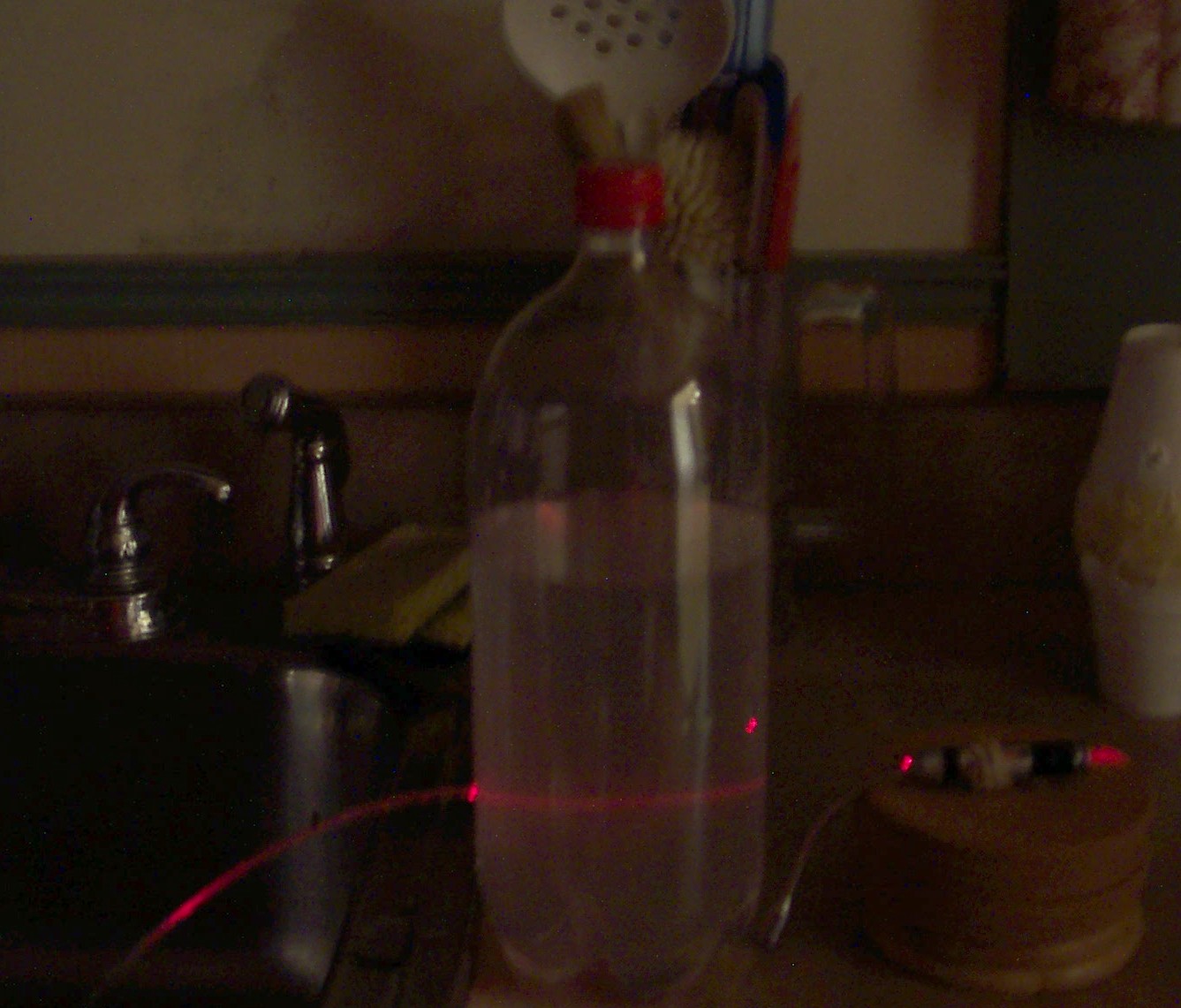
As we watch each episode, I've been jotting down ideas for labs we can do related to each topic. So far most of the topics have been related to Classical Physics. (You know, that stuff I thought would be too boring to go over last year.) I've really been enjoying the projects we've done. Tonight when it got dark we did a demonstration of Total Internal Reflection using a laser pointer and a soda bottle full of water. Check it out!

Wednesday, December 15, 2010

The Pop-up LHC: A Big Bang in a Book

My review of the pop-up book version of the Large Hadron Collider at CERN is over at GeekDad. It's a little more complicated than most pop-up books -- but then, the topic IS nuclear physics!

Buy it at Amazon!

Tuesday, November 30, 2010

Teaching Physics in Remote Places


This year we are doing "Integrated Science" using a video course by Prof. Robert Hazen called The Joy of Science. Hazen takes a chronological approach, so we are currently learning about classical physics. In the video Hazen describes simple experiments that can be done at home. We just tried one today, trying to find the declination of a compass needle towards the Earth's North Pole using paper clips, corks and a bowl of water. Our experiment had some problems, so afterwards we went online to look up other ways we could have designed it.

One resource that popped up is from The Institute of Physics is a scientific charity devoted to increasing the practice, understanding and application of physics to all audiences, from specialists to the general public. One of their resources is an online book of experiments called Teaching Physics in Remote Places. It seems perfect for doing physics in the home or classroom -- chances are your set-up isn't any more primitive than that used by the authors of this books!

Saturday, October 2, 2010

Now Blogging at GeekMom with Mythbuster Kari Byron!

I've been busy the past few months helping to launch GeekMom, a site dedicated to moms who want to share their geeky passions with their kids. To start us off, we've got MythBusters host Kari Byron writing about her new adventure as mom to a one-year-old girl. Kari is also the host of the new hour-long kids' show Head Rush. Check us out!

And I'll still be blogging at GeekDad, so be sure to stop by there too!

Tuesday, June 29, 2010

New Institute of Physics Website

The UK-based Institute of Physics is a scientific charity devoted to increasing the practice, understanding and application of physics. It has a worldwide membership of over 36,000 and is a leading communicator of physics-related science to all audiences, from specialists through to government and the general public.

From the IoP blog:

After a year in development and following several usability studies, the Institute of Physics (IOP) is today re-launching its website http://www.iop.org/.With its increased user-friendliness, the website makes it easier to navigate around and quicker to find information. Content has been specifically tailored for teachers, students, media, IOP members and those with a general interest in the Institute and physics.
 There are separate links for teachers, students, and the general public.

I also found a link to the website Practical Physics -- with over 700 experiments!  Below is an explanation of how ion trails are formed from their page on cloud chambers:

Alpha particle tracks (from Practical Physics)

Nuclear 'bullets' from radioactive atoms make the tracks in a cloud chamber. They hurtle through the air, 'wet' with alcohol vapour, detaching an electron from atom after atom, leaving a trail of ions in their path. Tiny drops of alcohol can easily form on these ions to mark the trail.

The trail of ions is made up of some ‘air molecules’ that have lost an electron (leaving them with a positive charge) and some that have picked up the freed electrons, giving them a negative charge.

Alpha particle tracks

There is no sighting of the particle which caused the ionisation, because it has left the ‘scene’ before the condensation happens. If you count the number of droplets an alpha particle might produce 100,000 pairs of ions by pulling an electron from 100,000 atoms.

Alpha particle tracks
Nuclear 'bullets' forming a trail of ions which are condensation nuclei

When the alpha particle has lost all its energy in collisions with the ‘air molecules’ it stops moving and is absorbed.