Showing posts with label Quantum mechanics. Show all posts

Friday, May 14, 2010

Physics on Stage


We just finished watching the PBS video of the play Copenhagen by Michael Frayn. It was a little tough going, but the kids got through it. From the PBS companion website:
Copenhagen is about Niels Bohr and Werner Heisenberg, two of the great scientific minds of the 20th Century, trying to make sense of a meeting they had in September 1941, while World War II raged around them. From the vantage point of the hereafter, the spirits of Bohr and Heisenberg, along with Bohr's wife Margrethe, are uncomfortable with the many unanswered questions from that fateful evening in 1941, most significantly: why did Heisenberg, a Nobel Prize winning physicist leading the German atomic bomb team, go to Copenhagen to meet with his old mentor Bohr, a half-Jewish Dane living in Nazi-occupied Denmark?

The website gives a little more background on the events and how Frayn shaped them into a play, as well as how the film version chose to visualize them. There's also a page of resources about Heisenberg's Uncertainty Principle, Quantum Mechanics, the Atomic Bomb and other scientific and literary aspects of the play. However, Frayn says on the website that a lot of the science was cut out of the play -- so maybe we should make the effort to read it as well.


A few months ago, at my suggestion, we read Tom Stoppard's play Arcadia with our bookclub. Arcadia is less obviously about physics, and it is also funny, so I think the kids probably enjoyed it a little more than Copenhagen. Although it's somewhat bawdy, Arcadia does touch on a lot of higher math and physics. If you understand something of those concepts, it adds to the comedy. I was lucky enough to see a live performance of Arcadia by the theater department of Skidmore College several years ago. The entire freshman class read the play, and it was taught in several different departments. (You can see some essays dealing with different aspects of the play on the Skidmore website.) However, it is rarely performed, and I can't find a video of the play for the kids. Hopefully they'll get to see it sometime.

There are other plays, stories and novels dealing with physics that we may get to at some point. But in the meantime, you can see some of my other suggested literary tie-ins by clicking on the link for my Amazon store in the sidebar on the right of the screen.

Monday, May 10, 2010

7 Wonders of the Quantum World


Over at New Scientist, Michael Brooks tours the quantum effects that are guaranteed to boggle our minds.

From undead cats to particles popping up out of nowhere, from watched pots not boiling – sometimes – to ghostly influences at a distance, quantum physics delights in demolishing our intuitions about how the world works.

Thursday, March 25, 2010

The Famous Double-Slit Experiment and the DIY Quantum Eraser

In How to Teach Physics to Your Dog, author and Union College Physics Professor Chad Orzel talks about an extension of the Double-Slit Experiment called the Quantum Eraser. According to Orzel -- and before him to physicist and wise guy Richard Feynman -- everything the average person needs to know about Quantum Physics is contained in the Double-Slit Experiment.

When Thomas Young first did the Double-Slit Experiment in 1803, he proved that light travels in a wave. He showed this by aiming a narrow beam of light at a barrier with one or two slits and placing a screen behind it. When the light went through one slit, it hit the screen in a single blob. But when it went through two slits, the light on the screen spread out into many stripes of dark and light -- which is what you would see if two waves were overlapping to create an interference pattern.

When Quantum Physics was introduced, the experiment was done with a stream of photons passing through the slits one photon at a time. Amazingly, over time the individual photons also created an interference pattern on a screen on the other side -- meaning that each single photon was interfering with itself as it passes through both slits at the same time!

The Quantum Eraser experiment just makes this weird result even weirder. First polarizing lenses with different orientations are put in place so that you can tell whether the light went left or right through the slits. "Labeling" the photons in this way makes the light go back to acting like particles -- the interference pattern is erased. And if you add still another polarizing filter, so that you can't tell which way the particles went, the pattern reappears!

When I read in Orzel's book that the May 2007 issue of Scientific American had a Quantum Eraser experiment you could do at home, I knew I had to try it! After a bit of searching, I was able to find the article online. (Actually, what I found is everything but the article, but the sidebars and other content include everything you need to do the experiment.) Like a lot of demonstrations that we try, it was a little hard to tell what, if anything, was happening, and I'm not sure it was completely successful. However, the results we did get were good enough to be worth sharing here. The article includes some trouble-shooting tips that may produce better outcomes if we ever try it again.

The experiment consists of four parts:
  1. Create a double-slit set-up using a cheap laser pointer as a light source.
  2. Add a right/left polarizing filter.
  3. Hold up a polarizing filter on a diagonal, which allows some "left" and some "right" particles to pass through.
  4. Make a polarizing lens which filters light on one diagonal on the top and the other on the bottom and add that to the set-up.
Obviously, since we were using a cheap laser pointer and weren't sending light through one photon at a time, this experiment doesn't prove that a single particle will go both ways at once, but it does give you a good approximation of what happens on a quantum level. Below is a description of what we did:

Materials:
  • laser pointer pen (from the supermarket)
  • polarized film (we used the lenses from cardboard 3D movie glasses)
  • thick rubber band
  • white foam-core board (for projection screen)
  • Styrofoam cups
  • unused twist ties
  • tape

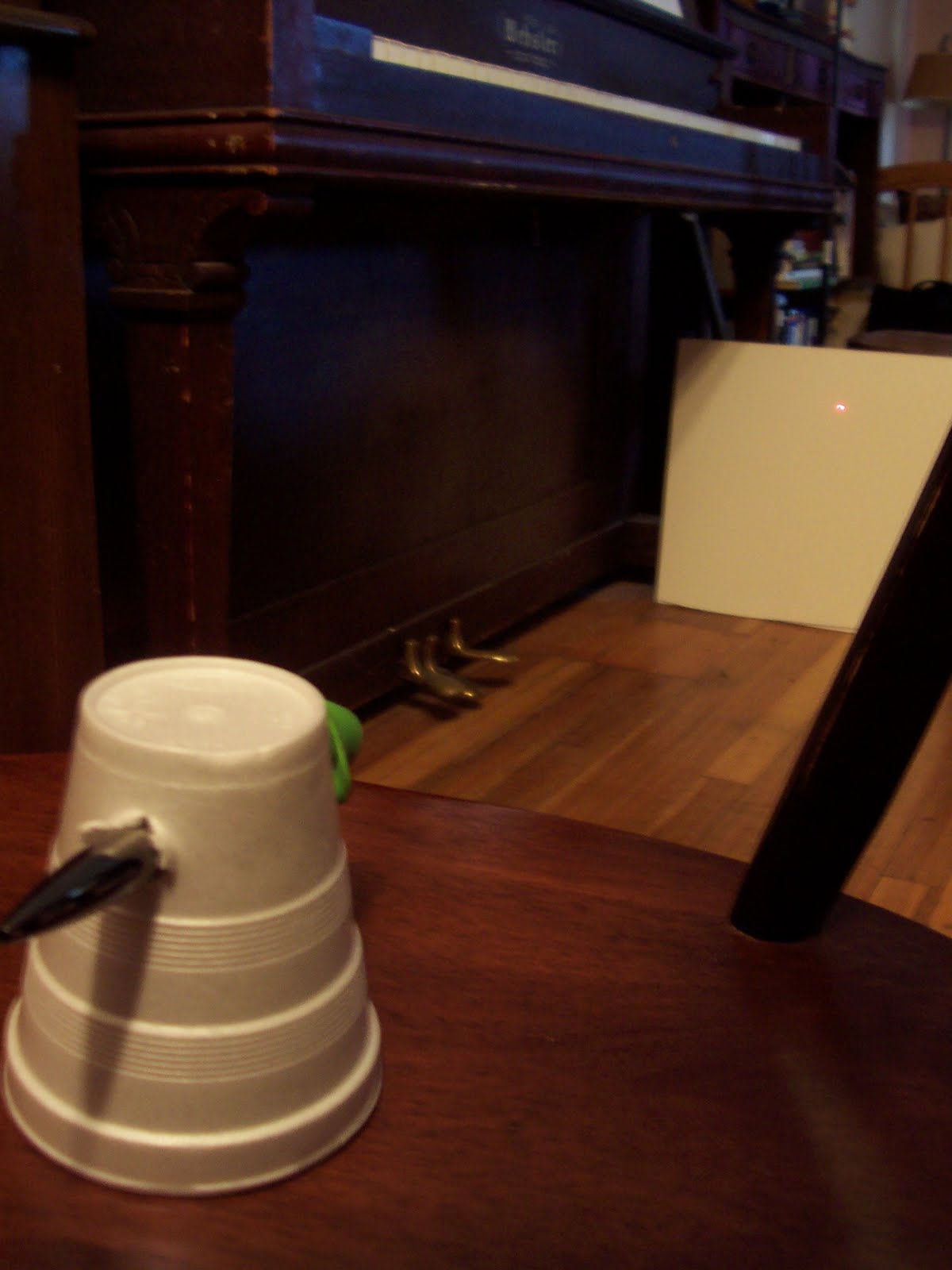
  1. First we made a stand for the laser pointer pen by pushing it through an upside-down Styrofoam cup.
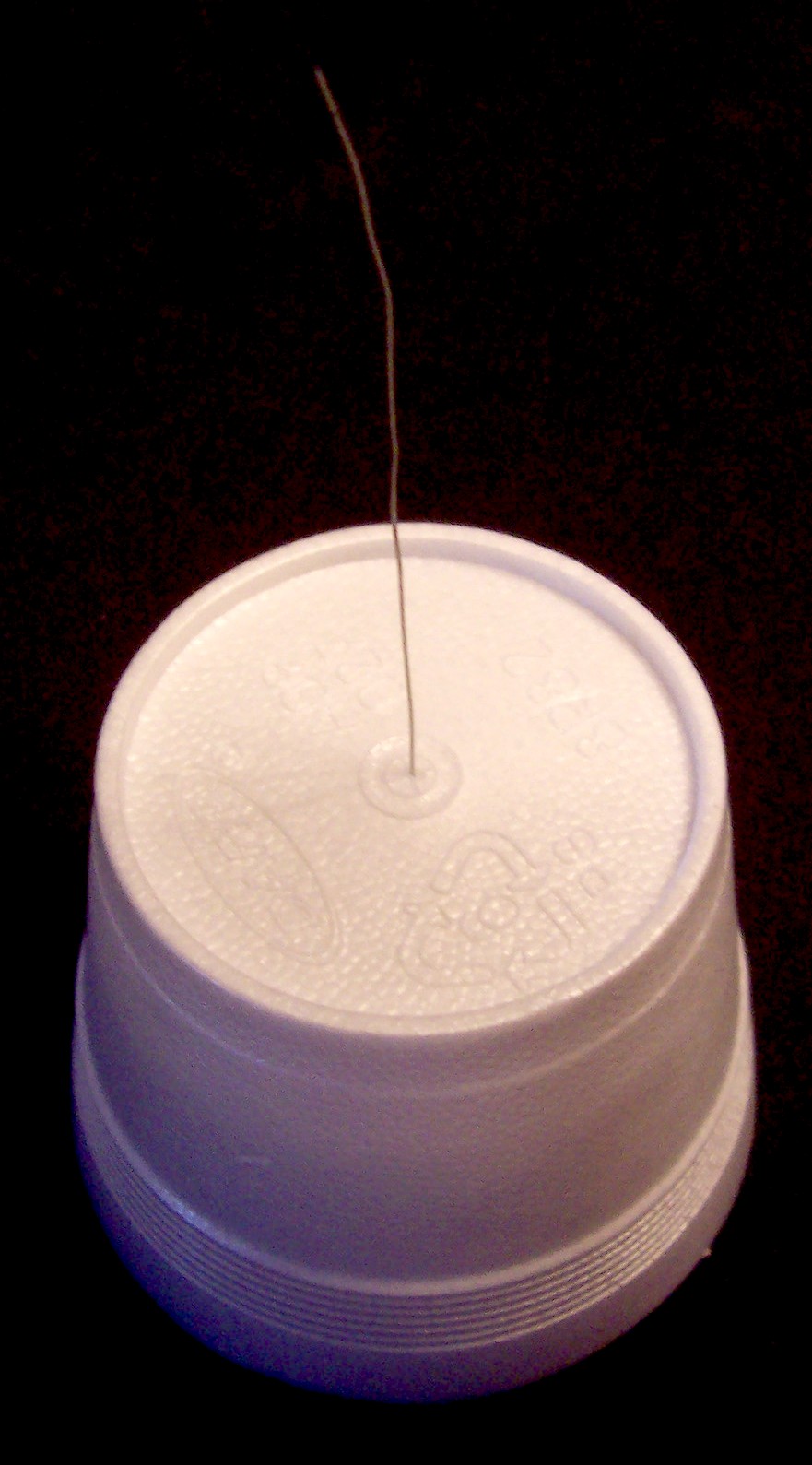
  2. Instead of a barrier with a slit, this version uses a vertical piece of wire to divide the light into "right" and "left." We cut the paper off of a twist tie and removed the wire without bending it. Then we made a stand for the wire by cutting around the top of a foam cup to make it shorter than the laser stand. We turned the cup upside down and poked the wire through the bottom so that it was standing straight up.
  3. We wrapped a rubber band around the laser's ON button so that it would stay on.
  4. The laser was put in its holder and placed on the seat of a chair. The foamcore projection screen was set up by leaning it against a chair about 6 feet away. We could see a small dot of laser light on the screen. (See directly above.)
  5. Then the wire in its holder was set up a few inches away from the laser. We moved it until it was in the path of the laser light. An interference pattern appeared! (Photo at top of post.)
  6. To make the labeler, we took the polarized glasses, and marked the lenses "right" and "left."  Then we cut them out, leaving the cardboard frame around everywhere but the inside edge (towards the nose piece). The two lenses were taped together so that the inside edges were just touching (no overlap or gap). Another twist-tie wire was taped along the join and trimmed.
  7. A holder was made by cutting off the top of another foam cup, then slicing a slot across the bottom. The labeler was set into the slot so that the wire was vertical in the center.
  8. The labeler was put in place of the plain wire. The light hitting the screen returned to blob form.
  9. Taking another pair of polarized lenses, we held up the "left" and "right" lens at a 45 degree angle between the labeler and the screen. At this point the light projected on the screen was hard to make out, but it did seem to spread out again like an interference pattern.
  10. Finally, we took a left and right lens, cut them on a diagonal, and taped them together so that one was on top and one on the bottom. According to the SciAm directions, we should have seen an interference pattern split so that the top was off to one side and the bottom to the other, like misaligned teeth. All we could see was misaligned blobs, though. (See below.)
As I said, if we try this again we will try moving some of the parts around to get better results. Just for the record, the glasses we used had lenses which were tilted at 45 degree angles, rather than the traditional horizontal and vertical. However, they were still perpendicular to each other, and we rotated each the proper amount from its starting point, so I don't think it mattered.

In my opinion, we achieved some interesting effects, for a living-room physics lab.
Reblog this post [with Zemanta]

Monday, March 22, 2010

What Every Dog Should Know About Quantum Physics

Union College Physics Professor Chad Orzel was kind enough to give a talk based on his new book, How to Teach Physics to Your Dog to a group of local homeschoolers I organized. Even better, he posted the video and slides he showed us in the talk on his blog! The presentation included a look at helium and neon lights using diffraction grating and a demonstration of the double-slit experiment using a laser beam. I'm adding the books he recommended -- some for a popular audience, some aimed at freshman physics students -- to my Amazon store as well.

After the talk, Dr. Orzel brought in his famous dog and co-author Emmy for a photo op. Then we got a tour of his laser cooling lab, the school's own basement particle accelerator, and the astronomy department's observatory. One interesting fact about Union is that, because there are no graduate students to compete with, undergraduates get to use the fancy equipment right from the start.

The talk was entertaining and informative. As you can see, the kids were as interested as the parents. Thanks to Dr. Orzel for such a great program!

UPDATE: Listen to an interview with Chad Orzel from WAMC Northeast Public Radio.
Reblog this post [with Zemanta]

Friday, March 12, 2010

The Many Worlds of Hugh Everett

We recently watched the PBS NOVA show Parallel Worlds, Parallel Lives about the late physicist Hugh Everett. In 1957, Everett came up with a scenario that would eliminate the Schrödinger's cat -- which said that light didn't take shape as wave or particle until someone was observing it. He called his theory "many worlds," and it proposed the idea that where two states are possible, each splits off into its own universe. Science fiction, especially Star Trek, later adopted the idea for stories involving parallel universes. But at the time, Everett's theory was dismissed by the big guns of physics, like Niels Bohr. Rejected, Everett left academia and went to work for private firms, never developing his theory any further.

Parallel Worlds, Parallel Lives explores the physics of Hugh Everett through his son Mark Oliver Everett. Mark Everett, also known as "E," is a member of the indie rock band EELS and author of Things the Grandchildren Should Know. Mark grew up with his father but had very little contact with him. As an adult, he decides to investigate his father's life and work, meeting with physicists who are trying to further his theories, and visiting with his old colleagues and friends at Princeton and elsewhere. He also uncovers boxes of papers taken from his father's home after the death of his sister and mother and turns them over to his father's biographer. As he says in the documentary, he has become the ambassador from the Everett family to the world.

I really love the NOVA videos we have watched so far this school year, because they both bring in a human perspective and make the most of today's video effects to illustrate difficult physics concepts. This one is no exception, and it has the added plus of being told from the point of view of someone who, like us, has no scientific background. The video is only an hour long and well worth borrowing from your library or adding to your physics teaching materials. There is, as always, clips and lots of supplementary material at the PBS website. My only complaint is that the classroom "activity" doesn't include an actual double-slit experiment, but used a computer simulation instead.

Saturday, February 6, 2010

Book Review: How to Teach Physics to Your Dog and The Macroscope


(I wrote this article for the Albany, NY Times Union newspaper. It originally appeared, in edited form, on January 24, 2010.)

When you think about it, “modern physics” isn’t really all that modern anymore. Einstein began drafting his theory of relativity in 1905, and quantum mechanics – which describes how things work at the sub-atomic level – was described by Max Planck in 1900. Today quantum mechanics is at the core of everything from bar code scanners to computer chips. It’s the most accurately tested theory in the history of science.
And yet very few people are aware of even its most basic concepts. Ideas like particle-wave duality (the fact that light and matter has both wave and particle nature) are rarely covered in college physics classes, let alone high school. So when Internet rumors claim that the CERN Large Hadron Collider, which smashes atoms together to see what pops out, is about to suck the Earth into a black hole, or when the latest DaVinci Code book features a physicist who uses “thought particles” to transform matter, most people don’t know what to believe.

That’s a gap two new books by local educators are hoping to bridge. In “How to Teach Physics to Your Dog,” (Scribner, 2009) author Chad Orzel explains quantum mechanics to Emmy, his German Shepard mix, in language so down-to-Earth and entertaining that even humans can understand. Why a dog? As Orzel, an associate professor in the department of physics and astronomy at Union College in Schenectady, explained recently, dogs have no preconceptions about where things come from. That makes it much easier for them to accept the idea of virtual particles and parallel universes.

“As bizarre as it seems to a human, as far as a dog is concerned dog treats appear out of the air,” Orzel said. “She will sit there staring, hackling at evil squirrels from another dimension.”

For readers, following Orzel as he discusses the probability of bunnies made of cheese suddenly appearing in the backyard, or whether dogs can use their wave nature to pass around both sides of a tree at the same time, makes modern physics easier to understand.

“As scientists,” Orzel said, “we speak about it in math. I wanted to find ways to get around that, to show how fascinatingly weird the world is without forcing them to go through three years of physics.”

At the same time, Orzel added, “There is some heavy stuff in the book -- decoherence, ‘many worlds’ theories – that you don’t often encounter in popular treatments of the subject. The nice thing about writing with the dog is that whenever things get a bit thick, I can have her break in.” At those times Emmy pipes up to remind Orzel, “I don’t want to describe the universe, I want to catch squirrels.”
The goal for Orzel is to help readers understand that although the universe is a really strange place, it still has rules, and physicists have been sucessful so far in understanding them.

“You can’t will yourself into another universe where you’re wealthy,” he said. “I hope the dog is cute enough to carry people past some of the need for it to be magic.”

While Orzel’s book was written for adults whose schooldays are behind them, “The Macroscope,” the first in the Adventures in Atomville series, aims to inspire kids who have yet to set foot in a physics classroom. It’s a fantasy story in which all the characters are atoms which behave in ways that reflect the properties of their particular elements. They eat (and emit) photons, and swat away pesky electron gnats. But the physics is hinted at, not explained outright. (A website explaining the science behind Atomville is under development.) Co-authors Jill Linz, a senior physics teaching associate at Skidmore College in Saratoga Springs, and Cindy Schwarz, a professor of physics at Vassar College in Poughkeepsie, both said that the plan was to pique kids’ interest, not lecture to them.

“We don’t necessarily want these kids to walk away knowing what’s going on with subatomic particles,” explained Schwarz. “We want them to keep the words in the back of their heads and feel more comfortable when they hear them again.”

Linz first developed Atomville as a way to reach non-science majors, and later went on to produce physics videos for elementary schools. Schwarz uses creative writing and music in her physics classes for non-majors, and has published a book of her students’ physics poems and stories called Tales from the Subatomic Zoo.
Linz and Schwarz are hoping schools will invite them in to talk about their book and about physics. Last spring Schwarz showed students in Poughkeepsie how atoms emit photons and letting them look through diffraction glasses to see the spectrum created by an element. She was happy to find that, months later, they still remembered the concepts they learned.

“They really got something out of this,” she said.

Saturday, November 28, 2009

Einstein's Big Idea

If it seems crazy to start our study of physics with relativity, then let me say that I had in fact, originally drawn up a nice teaching plan which followed a more traditional physics sequence -- motion and mechanics through December, heat and thermodynamics in January, electricity and magnetism in February -- and lightly touched on everything after classical physics in May or June. (The list of topics I made up came directly from the Physics4Kids website.) But as I began to look at the material to be covered and the possible activities we could do (some of which the kids did many years ago when a friend taught a co-op class using the book Teaching Physics with Toys), I thought about how much of this stuff I had retained from my own formal science classes in high school. The answer was, not much.

If you have been following me through our adventures with chemistry and biology, you know that I am an English major with a geeky bent who got high marks in high school science and then promptly forgot everything I “learned.” My goal is to do some interesting activities that might help my kids and I grasp some of the concepts of each science discipline with worrying about getting the “right result” or memorizing a lot of jargon. Right after I made up my traditional teaching plan, I read the essay mentioned in the post Quantum Mechanics in Middle School? And I realized that – as with biology, when we focused on microorganisms where much exciting research is being done today – what I really wanted to find out about was the new stuff being done in physics. In the few weeks that I’ve been working on putting this course together, I’ve heard several times that the theory of relativity is the basis of all modern physics. I imagine that it is the equivalent of evolutionary theory to biology – to study the subject without starting with that game-changing idea is to get a skewed picture of how the field is treated today.

All of which leads us to Einstein’s Big Idea, the PBS NOVA episode which we watched last week. I literally pulled it off the library shelf without really knowing what it was about. But as luck would have it, I think this has been an excellent entry point for our study of physics. Einstein’s Big Idea uses actors to recreate the lives of Einstein and his predecessors: Michael Faraday, Sir Humphry Davy, Antoine-Laurent Lavoisier, James Clerk Maxwell. There are also comments from living physicists and David Bodanis, author of the book E=mc2 on which the episode was based. Taking this personal approach, the show highlights something I never realized: how many women were involved in the development of modern physics. Along the names already mentioned, we meet Mme Lavoisier, who greatly helped her husband in his work; Emilie du Châtelet, math genius and companion of Voltaire; Lise Meitner, who split the atom and helped prove Einstein’s theory, but who had to leave Germany when the Nazis began persecuting Jewish scholars. And of course Mileva Maric, who gave up her own physics studies in college when she became Einstein's first wife and mother to his son. All of these women have been neglected in the popular history of science, and it was a revelation to discover their existence.

Beyond the personalities, Einstein’s Big Idea did a good job of explaining the concepts involved in a way that most teens and adults can understand, and showing how Einstein’s theory was built upon the work of others while forging a new path at the same time. I highly recommend this video to anyone who wants to begin to understand the basis of all physics today.
Reblog this post [with Zemanta]

Friday, November 13, 2009

Quantam Mechanics in Middle School?

I was searching for middle school level physics teaching resources (the level I think worthwhile for general enthusiasts) when I came across this interesting essay about how to use science education to get kids actually interested in science. It was written by Douglas E. Richards, author of a series of middle school science thrillers called The Prometheus Project, and appeared on a website called EarthSky. Here's a taste:

Bringing relativity, quantum physics, and genetic engineering to middle school

Imagine a seventh-grade science teacher announcing to her class, “For the next week, we’re going to do something different. First, you’ll never, ever, be tested on the material we’ll be covering. Second, we’ll be talking about scientific ideas so awesomely cool that you’ll swear I’m making them up. Concepts such as Einstein’s theory of relativity, quantum physics, cosmology, genetic engineering, and nanotechnology. Amazing science that I promise will be more surprising and harder to believe than anything you’ve ever read in a Harry Potter novel.”

Do you think this would get the class’s attention? You bet it would.

Given the importance of science to our collective futures, it isn’t enough for us to teach sets of facts for given scientific topics. It’s our job to stoke young imaginations as well. To show how fascinating, surprising, and mind-blowingingly cool science can be. To show that along with the rote memorization of scientific knowledge, science is about the infinity of what we still don’t know. It’s about world-changing ideas; about experiments that show the universe to be, in the words of Arthur Eddington, “not only stranger than we imagine, but stranger than we can imagine.”

And this is something that we, as a society, are not doing as well as we should.


Reblog this post [with Zemanta]